Showing posts with label the World We Want. Show all posts

Monday, May 13, 2013

What Happens after the Millennium Development Goals?

One of the primary issues I'm covering during my time at the Lutheran Office for World Community is the post-2015 dialogue, an ongoing process to create development goals to follow the completion of the Millennium Development Goals in 2015.  Unfortunately, while there's a lot of information out there on the web, I've yet to find a clear, concise and basic explanation of how the post-2015 dialogue is taking place.  What follows is a cross-post of a piece I wrote for Ecumenical Women that tries to fill that need.  While the piece specifically calls on the Ecumenical Women community to participate in the post-2015 dialogue, its equally appropriate for all of us to do so as global citizens.  I'd love to hear what you think!

As the CSW58 priority theme is “Challenges and achievements in the implementation of the Millennium Development Goals (MDGs) for women and girls,” Ecumenical Women is focusing over the next few months on educating our online community about the MDGs and ongoing dialogue about what will follow their completion.

If you don't know much about the MDGs or even what they are, that's okay! To read a recent EW post on the basics, click here. While we'll be going into each of the eight MDGs (and specifically how they relate to women and girls) soon, a dialogue on figuring out what will replace the MDGs in 2015, currently termed "the post-2015 development agenda," is already well underway, and you can participate in it! Thus, we thought some information about how the dialogue has unfolded so far, and how you can get involved, might be helpful.

There are currently a number of separate processes providing input into the post-2015 dialogue, and luckily the UN Foundation and Dalberg Analysis have mapped it out in the infographic below:
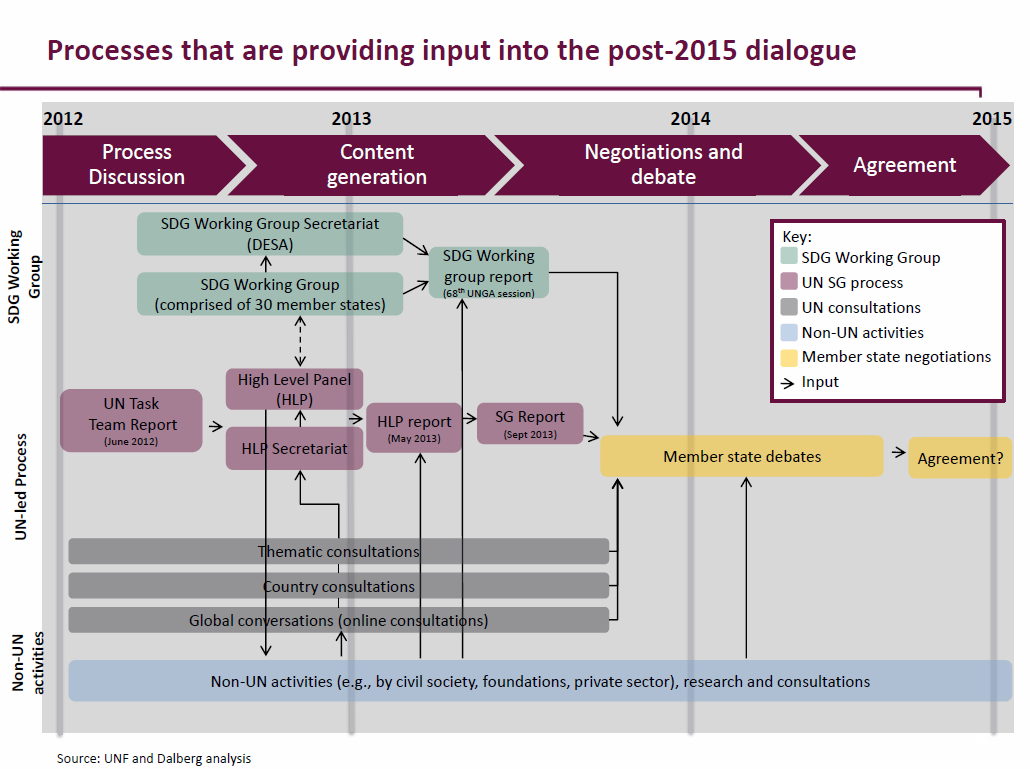
Post2015 Timeline

The Sustainable Development Goals (SDGs) Open Working Group was set-up this past January in response to recommendations from Rio+20, a United Nations Conference on Sustainable Development in 2012. While the working group is due to present its final recommendations to the UN General Assembly in September 2014, a draft report was released and opened for comments on 7 May, 2013. To read the draft report, click here. It remains to be seen however, if the SDGs will end up representing an entirely separate set of goals or will directly feed into the post-2015 development agenda.

The UN-led Process has a number of different moving parts. UN Secretary General Ban Ki-moon announced the creation of a High Level Panel to advise on post-2015 development agenda. The panel is co-chaired by President Susilo Bambang Yudhoyono of Indonesia; President Ellen Johnson Sirleaf of Liberia and Prime Minister David Cameron of the United Kingdom. After holding meetings in each of co-chairs' respective countries (as well as brief meeting at the 2012 General Assembly), the panel is scheduled to release its report at the end of May.

The UN, in conjunction with civil-society and other international organizations, is additionally leading 88 consultations in specific countries and 11 consultations on the following themes:
And here's where we as Ecumenical Women can lend our voice. All the links above will send you to specific consultation areas on the World We Want 2015, a web-platform created by the UN and civil-society to gather the priorities of people from every corner of the world.

If you'd prefer to provide more general input, you can create a profile and then answer questions like "World leaders are creating new development goals. What needs to be included?" on the World We Want 2015.

If you'd prefer to begin contributing through a basic survey, you can vote on your top priorities for development in the MY World survey.

There are also a number of non-UN activities feeding into the post-2015 dialogue. Beyond 2015, for instance, is a global civil society campaign that brings together more than 620 organizations.

So wow- that's a lot of information, but we hope you found it helpful. Be sure to participate in the World We Want, the MY World survey and please leave us a comment if you have any questions or concerns.

Finally, if you're interested in a more detailed timeline of the post-2015 dialogue, the Guardian has created a great resource that you can find here.

Dustin currently serves as Vicar at the Lutheran Office for World Community and Saint Peter's Church in Manhattan, having recently completed his second year of a Masters of Divinity program at the Lutheran Theological Seminary at Philadelphia. While seeking ordination in the Evangelical Lutheran Church in America, his focus is on the intersection between worship, service and justice in de-centralized faith communities unencumbered by a traditional church building. In his free time, Dustin likes playing frisbee, hiking and pretending to know how to sing.

Tuesday, October 16, 2012

Your Chance to Weigh In on 'The World We Want'

What follows is a cross-post I recently wrote on behalf of Ecumenical Women at the United Nations.

In 2000, world leaders came together to set quantifiable goals for global development to be reached by 2015 in eight areas. Some have described the goals that came out of that summit, the Millennium Development Goals, as the world’s greatest promise. The good news is that three years out from the goals’ deadline, three targets for reducing extreme poverty, improving clean water access and helping people move out of urban slums, have already been met. While there has been partial progress in some areas, such as moving toward gender equality in access to primary education, there has been little movement toward other targets like reducing the maternal mortality rate.

As the world inches closer to 2015 deadline, the United Nations is also working to analyze successes and failures of the Millenium Development Goal program overall, and most importantly, beginning to discern what’s next after 2015… and that’s where you come in. In partnership with civil society, the United Nations is currently leading a growing conversation with people all over the world who are contributed their input about how we should move forward as one global community. This conversation is happening on the World We Want 2015 web platform, and the topic for this week is gender inequalities.
How can you contribute to the conversation? First, talk with folks (especially girls and women) about gender inequalities in your local community, with a particular emphasis on how such problems are related to inequalities based on income, race/ethnicity, age, location, disability, and sexual orientation. Next, spend some time brainstorming how the post-2015 development framework could address the needs of specific groups of women, especially those from the most marginalized groups and those facing multiple forms of discrimination.

Once you’ve spent some time talking about and reflecting on the topic, you can post your input here. The conversation is currently being monitored by Emily Esplen from Womankind Worldwide, Nicole Bidegain from Development Alternatives with Women for a New Era (DAWN), and Rosa G. Lizarde from the Feminist Task Force (FTF) of the Global Call to Action Against Poverty, and they’ll also be responding to your comments. The recommendations emerging from you contributions will be included in a report presented at a high-level meeting in Denmark in February 2013 on inequalities and the post-2015 development agenda. Make sure to contribute soon though, as the comment period for this topic will end on October 24th. Thanks so much for contributing to The World We Want!

Dustin is currently a vicar at the Lutheran Office for World Community and Saint Peter's Church in Manhattan, having recently completed his second year of a Masters of Divinity program at the Lutheran Theological Seminary at Philadelphia. While seeking ordination in the Evangelical Lutheran Church in America, his focus is on the intersection between worship, service and justice building in de-centralized faith communities unencumbered by a traditional church building. In his free time, Dustin likes playing frisbee, hiking and pretending to know how to sing.